What is a Buchner Funnel? Uses, Setup and How Vacuum Filtration Works
1 min read
The Buchner funnel is the workhorse of vacuum filtration in New Zealand labs, separating a solid from a liquid far quicker than gravity. This guide explains what it is, what it is used for, how to set one up step by step, the main materials, and how vacuum filtration works, with an animated apparatus and a funnel finder.
Introduction
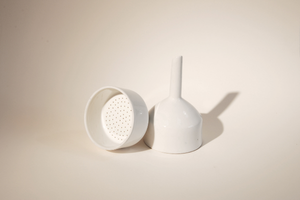
A Buchner funnel is a flat-bottomed funnel that teams up with filter paper and a vacuum to pull a solid out of a liquid in a hurry. It is the workhorse of vacuum filtration, moving the liquid through far quicker than gravity and leaving a firm, well-drained cake on the paper.
Across New Zealand it earns its keep in university and Crown Research Institute labs, and in environmental, water, food and primary-industry testing, wherever a solid needs collecting or a precipitate isolating. Set up with a filter flask and a vacuum source, it turns a slow drip into a quick, repeatable step.
Below we look at what a Buchner funnel is, what it is used for, how vacuum filtration actually works, how to assemble one step by step, and how to pick the right funnel for your bench.
What is a Buchner funnel?
It is a funnel with a flat, perforated plate near the base. A disc of filter paper rests on that plate, the solid-and-liquid mixture goes in on top, and a vacuum beneath draws the liquid through while the solid stays put as a cake.
By itself the funnel is only half the story. It drops into a thick-walled filter flask through an airtight adapter, and the flask links to a vacuum source. Tap a part below to see how it all connects. The funnel takes its name from the industrial chemist Ernst Buchner.
Tap a part to learn what it does.
What a Buchner funnel is used for
The shared theme is separating a solid from a liquid quickly, under vacuum. Common tasks on a New Zealand bench include:
- Gathering crystals after a recrystallisation
- Isolating a precipitate from a reaction
- Washing a solid product on the filter
- Pulling air through to dry the filter cake
- Filtering larger sample volumes at speed
- Recovering a catalyst or drying agent from solution
Since the vacuum both quickens the flow and helps dry the cake, the Buchner funnel is the natural pick whenever the solid is what you want to keep, rather than simply clearing a liquid.
How vacuum filtration works
It comes down to a difference in pressure. The vacuum drops the pressure beneath the filter paper, so everyday atmospheric pressure above the mixture drives the liquid through the paper much faster than gravity manages. Step through the setup and watch it run.
STEP 1 OF 6
How to set up a Buchner funnel
The animation above shows it visually. As a checklist to work through at the bench:
- Secure the filter flask. Clamp a thick-walled, vacuum-rated side-arm flask to a stand. A plain conical flask is not made for vacuum and can implode.
- Seat the funnel. Push the Buchner funnel into the flask neck with a snug rubber adapter, bung or ring, so the join holds air.
- Add and wet the paper. Sit a filter paper disc that covers every hole without riding up the sides, then dampen it with a little solvent so the mixture stays put.
- Connect the vacuum through a trap. Run tubing from the side arm to a trap bottle, then to a water aspirator or vacuum pump, so nothing gets drawn back into your filtrate.
- Apply vacuum and pour. Turn on the vacuum, then pour the mixture steadily into the middle of the funnel. The liquid is drawn through and the solid gathers as a cake.
- Wash, dry, then release. Rinse the cake with a little cold solvent, leave the suction on to dry it, then break the vacuum at the source before switching off to prevent suck-back.
Materials and types
Buchner funnels come in a handful of materials, each with a niche. Tap one to see where it fits.
BEST FOR
For very small quantities, its close cousin the Hirsch funnel is the one to reach for: same principle, but smaller, with sloped sides suited to milligram amounts of solid.
Find the right funnel
Three quick taps and we will suggest a funnel and material, with a link to shop it on LabFriend NZ.
1. How much solid are you collecting?
2. What is the sample chemistry?
3. Filter paper or a reusable frit?
Choose an option above to see a suggestion.
Common mistakes to avoid
A few habits cause most filtration trouble. Keep an eye out for:
- Reaching for a thin-walled flask not rated for vacuum, which can implode
- Skipping the wetting step, so the mixture creeps around the edges
- An oversized paper disc that curls up the sides and leaves a leak path
- Running without a trap, so water or oil is drawn back into the filtrate
- Turning off the pump before breaking the vacuum, which causes suck-back
- Pouring too quickly and overflowing the funnel
Each one costs you product or a clean result, so they are worth folding into your routine.
Vacuum vs gravity filtration
The Buchner funnel handles vacuum filtration, but gravity filtration still earns its place. Compare the two below.
Frequently asked questions
What is a Buchner funnel used for?
For vacuum filtration, separating a solid from a liquid quickly. It is most often used to gather crystals after a recrystallisation, isolate a precipitate, and wash and dry a solid product on the filter.
How does vacuum filtration work?
A vacuum drops the pressure below the filter paper. Atmospheric pressure above then pushes the liquid through much faster than gravity, and steady suction helps dry the cake.
What flask do I use with a Buchner funnel?
A thick-walled, vacuum-rated filter flask, also called a side-arm or Buchner flask. The funnel seats in the neck via an airtight adapter, and the side arm connects to the vacuum. A plain conical flask is not safe under vacuum.
Do I need filter paper?
Porcelain, glass and plastic funnels use a flat disc of filter paper on the plate. A sintered, or fritted, glass funnel has a built-in porous plate, so it filters without paper and can be cleaned and reused.
Buchner or Hirsch funnel, what is the difference?
They work the same way. A Buchner funnel has straight sides and a larger flat plate for grams of solid or more; a Hirsch funnel is smaller with sloped sides, made for milligram quantities.
Why wet the filter paper first?
A little solvent seals the paper flat against the plate, so the mixture cannot slip under the edge and the solid forms an even cake rather than escaping through.
How do I avoid suck-back into my sample?
Fit a trap bottle between the flask and the vacuum source, and always break the vacuum at the source, or pull the tubing off, before switching the pump off. Then liquid cannot flow back into your filtrate.
Final thoughts
The Buchner funnel is a simple piece of kit that makes filtration fast, clean and repeatable. Knowing how the vacuum does the work helps you assemble it safely, choose the right funnel and material, and finish with a cleaner, drier solid. For any New Zealand lab that isolates solids, it stays a bench essential.
Ready to filter faster?
Browse Buchner funnels, filter flasks and filtration gear at LabFriend NZ.
Frequently asked questions
Most orders ship within 24 hours and arrive in 3–5 business days depending on your location.
.png)
.png)